Dental Implants and the Future of Restorative Dentistry
A missing tooth changes more than a smile. It alters the way a person chews, the way speech sounds, the way the lips are supported, and often the way confidence shows up in everyday life. In the clinic, those consequences rarely arrive all at once. They accumulate. A patient starts favoring one side when chewing. A neighboring tooth drifts. The bite changes slightly, then more noticeably. Bone in the edentulous area begins to resorb because it no longer receives the stimulation that natural tooth roots once provided. By the time someone seeks treatment, the conversation is often about much more than replacing a tooth.
That is why Dental Implants have become such a defining development in restorative dentistry. They do not simply fill a space. They create the possibility of restoring function in a way that respects anatomy, biomechanics, and long-term oral health. For many patients, they also represent the first treatment option that feels truly stable, especially after years of removable appliances or repeatedly failing bridges.
The future of restorative dentistry is not built on one material or one surgical protocol. It is being shaped by the integration of implant therapy with digital planning, tissue preservation, regenerative procedures, and a more disciplined understanding of what makes treatment succeed over ten or twenty years, not just on delivery day. Dental implants sit at the center of that shift.
Why implants changed the restorative conversation
For decades, replacing missing teeth often meant choosing between a removable partial denture and a fixed bridge. Both still have valid roles. A well-made bridge can serve a patient beautifully in the right case, and removable prosthetics remain important when budget, health status, anatomy, or treatment goals make them the most sensible option. But both approaches involve trade-offs that implants often avoid.
A traditional bridge usually requires preparation of adjacent teeth, sometimes healthy teeth, to support the restoration. A removable partial can restore function, but many patients dislike movement, food trapping, or the visible clasps that may accompany certain designs. Implants introduced a different concept: replace the missing root first, then build the crown from a stable foundation. That single Dental Implants idea reshaped treatment planning.
In practice, the difference is profound. Consider a patient in their forties who loses a lower first molar after a cracked tooth and failed endodontic retreatment. If the neighboring teeth are unrestored and healthy, preparing them for a bridge can feel like borrowing trouble from the future. An implant allows the clinician to restore the site without sacrificing intact enamel on adjacent teeth. It is a conservative decision, even though it involves surgery.
The appeal is not only structural. Patients understand stability instinctively. They may not know the details of osseointegration, torque values, or peri-implant tissue management, but they know what it means to chew steak on both sides again without hesitation. They know what it means to smile without the slight inward collapse that can follow anterior tooth loss. The popularity of implants came from outcomes patients could feel in daily life.
Osseointegration remains the foundation, but it is no longer the whole story
When implants entered mainstream care, the miracle was osseointegration. Titanium placed in bone could heal into a stable interface capable of supporting function for years. That principle still underpins everything. Yet contemporary restorative dentistry has matured past the idea that placing an implant into bone is enough.
Today, success is judged on several fronts at once. The implant must integrate. The restoration must function under real occlusal forces. The soft tissue architecture should be healthy and, in visible areas, esthetically convincing. The patient must be able to clean the site effectively. The prosthetic design must allow maintenance and, when needed, repair. An implant can be integrated and still be a poor restorative result if it is placed too far facially, if the crown emerges unnaturally, or if the patient cannot keep it plaque-free.
That is where the future of restorative dentistry is heading, toward a more unified way of thinking. Surgical placement and restorative design can no longer be separated into neat silos. The most reliable implant outcomes begin with the end in mind. Position the implant where the restoration needs it, not merely where bone happens to be available at first glance.
This sounds obvious, but it is one of the lessons the profession learned the hard way. Earlier implant eras sometimes prioritized successful integration over restorative ideality. Many of those implants survived, but not all of them aged gracefully. Screw access holes emerged in awkward locations. Soft tissue receded. Hygienic access was poor. The next generation of care is more exacting because clinicians now appreciate that survival and success are not interchangeable terms.
The digital turn is making better treatment possible
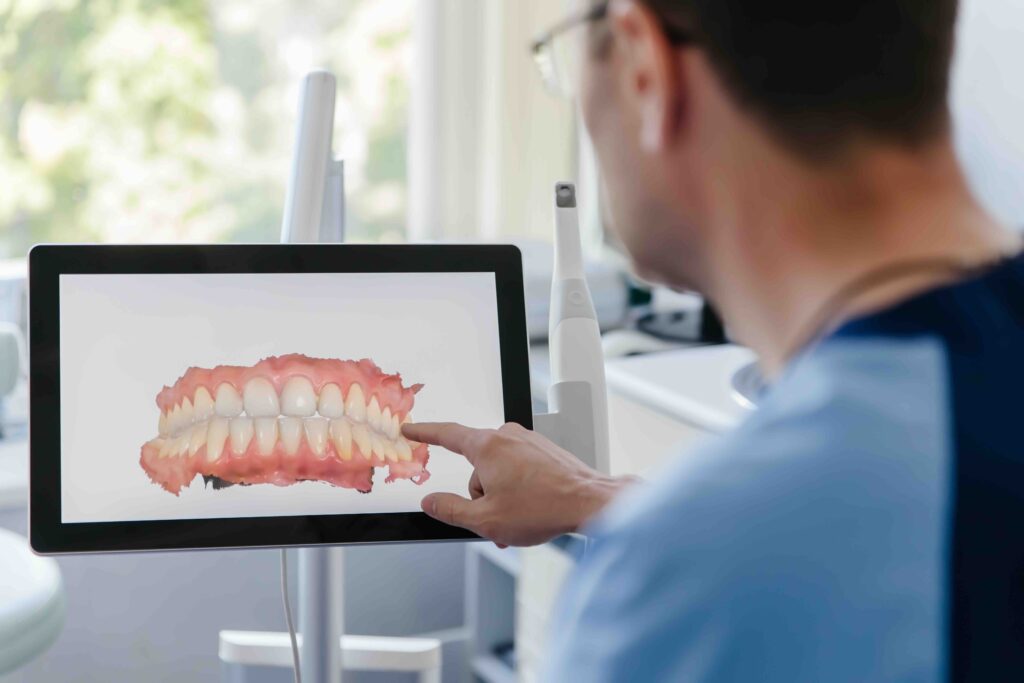
Digital workflows have already changed implant dentistry in practical, visible ways. Cone beam computed tomography, intraoral scanning, facial photography, and virtual treatment planning now allow clinicians to assess bone volume, identify anatomic limitations, visualize prosthetic space, and plan implant position with a degree of precision that was difficult to achieve consistently in the analog era.
This matters most when margins are tight. In the anterior maxilla, a millimeter can determine whether the final result looks natural or artificial. In the posterior mandible, accurate planning helps protect the inferior alveolar nerve while still maximizing implant length and stability. In full-arch cases, digital coordination reduces uncertainty in implant angulation, restorative space, and provisionalization.
There is also a quieter but equally meaningful benefit: communication. When a surgeon, restorative dentist, dental technician, and patient can all review the same digital plan, the conversation becomes clearer. Expectations improve. Risk becomes easier to explain. Laboratory workflows become more predictable. A complex treatment that once relied heavily on handwritten notes and stone models can now move through a more coordinated chain.
Still, digital dentistry is not an automatic safeguard against bad judgment. A beautifully rendered plan can still be biologically unwise. Guided surgery can improve precision, but a guide does not decide whether a site needs grafting first, whether a patient’s parafunctional habits will overload a restoration, or whether the soft tissue phenotype can support the intended esthetic outcome. Technology extends clinical judgment. It does not replace it.
Bone and soft tissue management are moving to the front of the plan
One of the clearest signs of progress in restorative dentistry is the growing respect for hard and soft tissue preservation. Earlier treatment philosophies often focused on replacing what was lost after extraction. The current direction is more preventive: preserve ridge dimensions when possible, stage treatment thoughtfully when necessary, and create conditions that support stable tissue over time.
Socket preservation has become part of this shift. Not every extraction site requires grafting, but many benefit from it, especially when future implant placement is likely. Preserving ridge contour can simplify later surgery and improve restorative outcomes. In esthetic zones, where tissue collapse can be unforgiving, early intervention often pays dividends months later.
Soft tissue is receiving the same level of attention. Patients may assume the implant itself determines the esthetic result, but experienced clinicians know that gingival architecture often makes or breaks the case. The thickness of the tissue, the shape of the emergence profile, the presence or absence of keratinized tissue, and the management of papillae all influence how natural the restoration appears and how resilient it remains.
This is especially relevant in single-tooth anterior cases. A technically integrated implant with a mismatched gingival margin can disappoint a patient even if every radiograph looks excellent. As restorative dentistry evolves, implants are being judged not just by survival rates but by their ability to mimic nature closely enough that the replacement disappears into the smile.
The best implant case is still the one chosen well
Not every missing tooth should be replaced with an implant, and not every patient is an ideal candidate on the day they first inquire about one. Good treatment planning depends on restraint as much as enthusiasm.
Several factors shape whether Dental Implants are appropriate:
- systemic health and healing capacity, including diabetes control, smoking status, and medications that affect bone metabolism
- local anatomy, such as bone volume, sinus position, nerve location, and soft tissue quality
- occlusal forces, including bruxism, deep bite relationships, and the demands placed on posterior restorations
- patient goals, hygiene habits, tolerance for surgery, timeline, and budget
- the condition of adjacent teeth, because preserving healthy structures may strengthen the case for implants, while strategic bridgework may sometimes be more realistic
The nuance lies in balancing these factors rather than reducing them to a simple yes or no. A smoker is not automatically excluded, but the risk discussion must be more candid. A patient with limited bone may still be treatable, but perhaps not with the simplest protocol. Someone eager for an immediate tooth replacement may be suitable for immediate provisionalization in one situation and a poor candidate in another, depending on primary stability, occlusal control, and tissue biotype.
Experienced clinicians often earn trust not by saying yes quickly, but by explaining when waiting, grafting, or choosing another restoration is wiser.
Immediate implants, immediate loading, and the demand for speed
Patients increasingly ask whether an implant can be placed the same day a tooth is removed, and whether they can leave with a tooth already attached. Sometimes the answer is yes. Sometimes yes is possible but unwise. Sometimes no is the safest answer.
Immediate implant placement can reduce treatment time and preserve tissue contours, particularly in selected anterior cases. Immediate provisionalization can offer significant psychological and esthetic benefits. Few moments in restorative dentistry feel as rewarding as replacing a failing front tooth while helping the patient avoid a removable temporary.
But these faster protocols demand discipline. The extracted site must be suitable. Infection, bone defects, soft tissue limitations, and inadequate primary stability can all change the recommendation. The provisional restoration must also be designed carefully, often Dental Implants out of functional contact during healing. Patients hear "same day" and imagine instant normality. Clinicians know that immediate treatment often requires stricter postoperative caution, not less.
The broader trend here is worth noting. The future of restorative dentistry will continue to reduce unnecessary delay, but the profession is also getting better at defining when speed serves biology and when it threatens it. Faster is attractive. Predictable is better.
Full-arch implant rehabilitation is redefining what is possible
Perhaps nowhere is the transformative power of implants more visible than in full-arch rehabilitation. For patients who have struggled with unstable dentures, severe tooth loss, or terminal dentition, implant-supported full-arch prostheses can feel life-changing. Speech improves. Chewing efficiency returns. Social confidence often rebounds with surprising force.
These cases also reveal how far restorative dentistry has come in planning and execution. What once required prolonged, highly segmented treatment can now, in selected situations, be managed with a coordinated approach that combines extractions, implant placement, provisional full-arch restoration, and staged refinement. That level of transformation was difficult to imagine as routine care a generation ago.
Yet full-arch treatment also attracts unrealistic marketing. It can be presented as simple when it is anything but. These are demanding cases with significant consequences if poorly executed. Passive fit, implant distribution, restorative material choice, hygiene access, phonetics, lip support, and maintenance all matter. A patient may leave thrilled on the day of delivery, then struggle months later if the prosthesis is hard to clean or if the bite was not managed properly.
Material selection illustrates the trade-offs clearly. Acrylic hybrid prostheses are often more affordable and can be very effective, but they may wear or fracture over time. Zirconia options can offer durability and esthetics, yet they come with their own cost and design considerations. There is no universally superior answer. The best choice depends on force patterns, esthetic demands, finances, reparability, and clinician experience.
Maintenance is becoming the true long game
The next chapter in implant dentistry is less glamorous than placement surgery, but more important: maintenance. As more implants remain in function for decades, the profession is confronting the realities of peri-implant disease, restorative wear, screw loosening, component replacement, and the cumulative effects of imperfect hygiene.
Natural teeth and implants do not fail in the same way. Teeth can decay. Implants cannot. But implants can lose supporting bone when plaque control is poor or when prosthetic contours trap biofilm. Patients sometimes assume an implant is invulnerable because it is made of metal and ceramic. In fact, an implant restoration can be more demanding to maintain than a natural tooth because the biologic seal is different and access for cleaning may be less forgiving.
This has practical implications for the future of restorative dentistry. Implant planning must increasingly account for maintenance from the beginning. Can the patient thread floss or use interdental brushes effectively? Is the prosthesis cleansable? Are recall intervals appropriate to risk level? Is there a baseline record of tissue health and radiographic bone levels? Those questions should not be afterthoughts.
A decade from now, the most respected implant practices are likely to be the ones that treat long-term maintenance as part of the restorative service, not an optional add-on after case completion.
The restorative dentist’s role is expanding
Implants are often discussed as a surgical achievement, but their future is deeply restorative. The final prosthesis determines how forces are distributed, how tissue is supported, how the patient cleans the area, and how natural the result appears. As implant treatment becomes more common, the restorative dentist’s role in diagnosis, sequencing, temporization, and maintenance becomes even more central.
This is particularly evident in interdisciplinary cases. Orthodontics may create space or improve root alignment before implant placement. Periodontal therapy may improve tissue health first. Oral surgery may remove hopeless teeth and graft sites. Prosthodontic planning may define vertical dimension and occlusal scheme before a single implant is placed. Complex dentistry works best when restorative goals guide the sequence.
That philosophy also changes how clinicians talk to patients. Instead of discussing implants as isolated hardware, they are framed as part of a larger rehabilitation plan. A patient with severe wear, multiple missing teeth, and a collapsed bite may technically need implants, but the real need is comprehensive reconstruction. The implant is one component, not the entire story.
What patients are likely to see in the next decade
The future is not a single dramatic leap. It is a steady refinement of planning, execution, and follow-up. Patients will probably notice some of these changes more than others, especially the ones that make treatment clearer and less disruptive.
Several developments are likely to define the next phase:
- more prosthetically driven digital planning, with scans and imaging combined earlier to reduce surprises
- greater use of tissue preservation and regeneration techniques to improve long-term esthetics and stability
- shorter treatment timelines in selected cases, but with clearer criteria for when immediate protocols are appropriate
- restorative materials and component designs that prioritize retrievability, hygiene, and durability
- stronger maintenance models, including personalized recall intervals and earlier intervention for peri-implant inflammation
What patients may not notice as easily is that the profession is becoming more conservative in the best sense of the word. Not conservative about innovation, but conservative about biology. There is a growing recognition that flashy treatment means little if tissue stability fades after three years. Long-term function is the standard that matters.
Cost, access, and the reality of decision-making
Any honest discussion of Dental Implants must address cost. Implant therapy can be expensive, especially when grafting, provisional restorations, multiple specialists, or full-arch treatment are involved. For many patients, the clinical question is not simply "Is an implant ideal?" But "Is an implant realistically attainable?"
This does not diminish the value of implants. It underscores the need for transparent treatment planning. Sometimes a phased approach works well, preserving options without forcing a patient into a rushed decision. Sometimes a removable prosthesis is the best bridge to future implant treatment. Sometimes a conventional fixed restoration remains the most rational compromise.
Dentistry serves people, not ideals. The future of restorative care will be strongest if it remains flexible enough to deliver good outcomes across a range of budgets and circumstances. Implant dentistry should elevate standards, not narrow compassion.
Where the field is headed
If one theme ties the future of restorative dentistry together, it is integration. Implants are no longer viewed merely as titanium fixtures that happen to support crowns. They are part of a larger system involving diagnosis, tissue preservation, esthetics, biomechanics, digital design, and lifelong maintenance. That broader view is making treatment better.
The most promising advances will not necessarily be the most dramatic ones. They will be the refinements that reduce guesswork, preserve more anatomy, improve communication among clinicians, and help patients keep their restorations healthy for longer. Better emergence profiles. More thoughtful grafting decisions. Cleaner prosthetic contours. More realistic risk conversations. Better recall systems. Those improvements rarely make headlines, but they are what move clinical outcomes forward.
Dental implants have already transformed the way missing teeth are replaced. Their future lies in becoming even more precise, more biologically respectful, and more deeply integrated into comprehensive restorative care. For patients, that means treatment that looks more natural, functions more predictably, and lasts with fewer complications. For clinicians, it means a higher standard, one that asks not just whether an implant can be placed, but whether the entire result will still make sense years later.
That is the future worth building.
Oaks Dental
5000 Parkway Calabasas Suite 308
Calabasas, CA 91302, United States
+1 818-431-2000
FAQ About Dental Implants
What is the downside of a dental implant?
Implants require surgery and a healing period that can last several months. Possible complications include infection, nerve or sinus injury, damage to nearby teeth and failure to bond with bone. Your dentist should assess your health, bone support and alternatives before recommending treatment.
What do dental implants typically cost?
There is no single price for every implant case. The number of teeth replaced, implant components, final restoration and any grafting or extractions affect the total. Request a written estimate covering every stage and confirm insurance benefits and out-of-pocket costs with the practice.
How long do tooth implants last?
An implant can provide long-term support and may last a lifetime with good oral hygiene and regular dental care, but this is not guaranteed. The crown or other restoration may need replacement sooner. Smoking, gum disease and some health conditions can reduce implant success.
