Balancing Human Judgment with Automated Output for Sensitive Business Work
When a business task involves sensitive data, regulatory compliance, or direct impact on customers, the question of whether to rely on human review or automated output becomes critical. Generative AI applications can draft responses, summarise documents, and flag patterns at tremendous speed. Yet human judgment remains essential for tasks where context, nuance, and ethical boundaries matter. Finding the right balance between the two is at the heart of responsible AI training.
What makes a task "sensitive"?
A task is sensitive when an error could cause financial loss, legal liability, privacy breaches, or reputational harm. Examples include reviewing loan applications, handling customer complaints in regulated industries, screening job candidates, or generating medical advice. In these cases, the cost of a mistake is high enough that pure automation, however fast, carries unacceptable risk.
Strengths and limits of automated output
Automated systems excel at volume, consistency, and speed. They can process thousands of documents in minutes and apply the same rules every time. For tasks such as flagging duplicate records, extracting structured data from forms, or generating first drafts of routine correspondence, automation is highly effective. However, automated models have well-documented blind spots. They may reflect biases in their training data, misinterpret sarcasm or cultural references, and produce confident-sounding but factually wrong answers. When the data changes or edge cases arise, the model may fail in ways that are hard to predict without human oversight.
The irreplaceable role of human review
Human reviewers bring contextual understanding, ethical judgment, and the ability to weigh competing values. In sensitive tasks, a human can recognise when a rule should be set aside because of special circumstances. For instance, a loan officer might approve a borderline application after a personal conversation reveals mitigating factors that no automated system could capture. A compliance officer can spot a subtle pattern that suggests fraud, even when each individual transaction looks normal. Humans also provide accountability: when a decision affects someone's life, a person can explain the reasoning and accept responsibility.

When each approach suits best
Pure automation works well for low-risk, high-volume tasks where speed and consistency are paramount and errors are easily corrected. Examples include generating personalised email greetings, tagging content for internal routing, or summarising public data. Human-only review is best for tasks that require empathy, creative problem-solving, or deep domain expertise, such as counselling, negotiation, or strategic planning. The middle ground, where most sensitive business tasks reside, benefits from a hybrid approach: automation handles the routine, high-speed parts, and humans review the outputs for accuracy, fairness, and appropriateness before any decision is finalised.
Building a hybrid workflow
A common pattern is to have generative AI produce a draft or recommendation, then route it to a human for validation. The human can approve it as is, edit it, or override it entirely. The system logs every decision and feeds corrections back to improve future outputs. This approach preserves speed for straightforward cases while catching errors in ambiguous ones. It also builds a record of where the model tends to go wrong, which is valuable for ongoing model improvement. One way to learn how to set up such workflows in practice is through a structured programme like the United Ceres College generative AI principles course, which covers the practical steps for integrating human oversight into generative AI deployments.
Training people and models together
Responsible AI training is not only about the technology. It also means training the people who work with it. Reviewers need to understand how the model was built, what its known biases are, and how to spot a mistake. They need clear guidelines on when to trust the output and when to investigate further. Organisations that invest in this dual training, both for the model and for its human operators, are better positioned to avoid costly errors and to build trust with their users and regulators.
Trade-offs to consider
Adding human review to an automated pipeline increases latency and cost. For many tasks, the extra time is worthwhile, but for others it may defeat the purpose of automation. A thoughtful design weighs the severity of potential errors against the efficiency gains. Some organisations use a tiered approach: low-risk outputs go straight to the customer, medium-risk outputs get a quick human check, and high-risk outputs require full review. The thresholds for each tier should be set by domain experts and reviewed regularly as the system learns and changes.
Ethical and legal dimensions
Regulations in many jurisdictions require a human in the loop for decisions that affect credit, employment, housing, or healthcare. Even where not legally mandated, having a human review automated outputs is good practice for fairness and accountability. A model may perform well on average but fail systematically for a minority group. Human reviewers, if properly trained and supported, can catch these failures. The United Ceres College generative AI principles course addresses these issues directly, helping professionals understand where human oversight is legally required and how to implement it effectively.
Practical steps for getting started
If you are responsible for deploying generative AI in a sensitive business context, begin by mapping every task the system will perform. For each task, note the risk level, the typical volume, and the cost of a mistake. Then decide on the appropriate level of human involvement. Start with a pilot where all outputs are reviewed, and use that data to calibrate your confidence thresholds. As the system proves its reliability, you may choose to automate more, but always keep a mechanism for escalation when the model is uncertain. Document every override and use it to retrain the model. Over time, the human role shifts from checking every output to handling edge cases and improving the system.
The role of responsible AI training
Responsible AI training is the disciplined practice of designing, deploying, and monitoring AI systems with a focus on fairness, transparency, and accountability. It goes beyond technical accuracy to consider the broader impact on stakeholders. For professionals building generative AI applications, this training covers how to select appropriate use cases, how to test for bias, how to document assumptions, and how to build feedback loops that include human judgment. It also emphasises the importance of clear communication with end users about what the system can and cannot do.
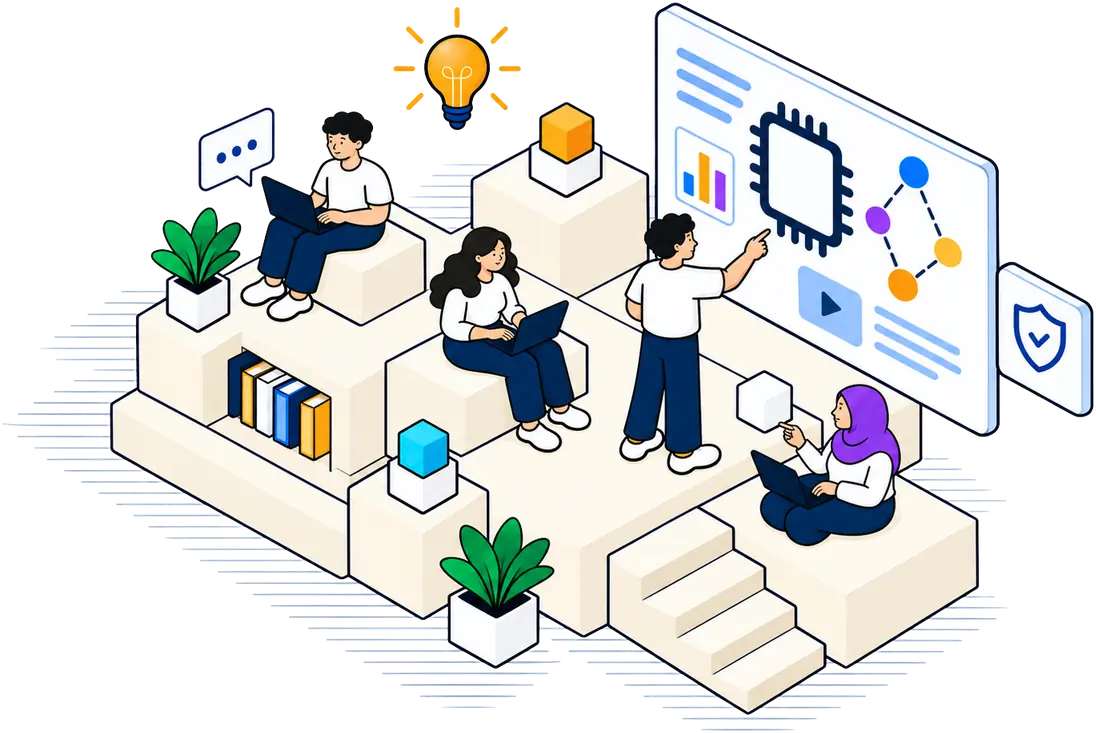
Ultimately, the choice between human review and automated output is not binary. The most effective approach for sensitive business tasks is a thoughtful combination of both. Automation handles the heavy lifting, and humans provide the context, empathy, and accountability that machines cannot. Organisations that invest in responsible AI training for their teams will be better equipped to strike that balance, building systems that are both efficient and trustworthy.
United Ceres College on social media
 Twitter
 LinkedIn
 Facebook
 Instagram
 YouTube
