Bully-Proof Basics with Kids Taekwondo Classes
Bullying rarely looks like a movie scene. It creeps in through whispered jokes, exclusion at recess, a shove in the hallway, a group text that turns sour after dinner. Parents often notice the ripple effects first: a stomachache on school mornings, a backpack that never gets opened at home, a once-chatty child who now shrugs and heads to their room. Kids taekwondo classes will not erase every tough moment, but they give children a toolkit to navigate them. The training blends physical skill with practical, repeatable habits that help kids stand tall, set boundaries, and get help when they need it.
I coach in kids martial arts programs and have seen hundreds of students grow through this work. The strongest changes do not come from a single “self-defense trick,” and they certainly do not rely on meeting aggression with aggression. Real bully-proofing is a layered approach. It teaches kids to read situations, use their voice, hold confident posture, protect their space when needed, and follow through with adults. Good schools also loop parents in so everyone pulls in the same direction. The goal is not to turn your 8-year-old into a superhero, it is to help them move through the world with agency and safety.
What bully-proofing really means
Bully-proofing is not a guarantee that your child will never be targeted. It is the skill set to reduce risk, shorten incidents, avoid escalation, and recover with support. A child who learns to spot grooming behaviors, use clear language, and walk away early prevents many problems. When a situation gets physical, the same child knows simple shields and escapes, not fancy combos. Later, they can report the incident calmly and clearly, with times and places, which makes school follow-up much more effective.
In kids taekwondo classes, we fold these elements into the culture of training. A child learns to start in a respectful ready stance, take a breath, and deliver a strong kia - that focused exhale and shout - on a kick. The physical drill lines up with a social skill: steady posture, grounded breath, assertive voice. Over months, this becomes their default under stress. It seems small, yet it shows up in real life when a child squares their shoulders at the bus stop and says, “Stop. That’s not okay.” Often, that clear signal is enough.
The three pillars: voice, space, and support
The first pillar is voice. Bullies tend to test in small ways, looking for uncertainty. Kids who can speak loudly and clearly cut off a lot of testing. We practice this in class through call-and-response, confident answers to instructors, and partnered scenarios where kids rehearse lines such as, “Back off,” “Stop touching me,” and “I’m not playing that game.” Voice also covers tone and word choice. Yelling insults invites more trouble, while strong, simple statements set boundaries without adding fuel.
The second pillar is space. Taekwondo’s stance work is body language training in disguise. Feet shoulder-width apart, chin level, eyes forward, hands up but open. This is not a fighting stance, it is a protective one that reads as confident and prepared. From there, we teach simple footwork to angle off a line, maintain distance, and place a barrier such as a backpack between your child and another person. The plan is not to “win,” it is to create room to leave.
The third pillar is support. Even skilled kids need adults. Bully-proofing fails when children think they must handle everything alone. Good programs build a habit of reporting concerns early. We coach kids to describe what happened using clear facts instead of loaded labels: who, what, when, where, and what they tried. Parents and instructors then follow through. When a school like Mastery Martial Arts partners with families, a child sees that reporting is not tattling, it is teamwork.
Why taekwondo, and not just any sport
Team sports do plenty of good. Confidence grows through repetition, friendships form, and kids learn grit. Still, kids taekwondo classes add three ingredients that matter for bully-proofing.
First, repetition under mild stress. In most classes, a child will perform in front of others, answer with spirit, and hold eye contact with instructors. It is safe and encouraging, yet it raises the pulse just enough to simulate the stress that comes with conflict. Confidence gained in those tiny pressure-cooker moments transfers to the playground.
Second, structured boundary-setting. Respect is hard-coded into kids martial arts culture. A bow, a handshake, a fixed distance between partners, escalation rules that prevent roughness. These rituals teach kids how to enter and exit interactions cleanly. Boundaries feel normal, not rude.
Third, self-defense with an ethical frame. Many parents worry that martial arts will make a child more aggressive. In good schools, the opposite happens. Curriculum and coaching emphasize control, restraint, and the hierarchy of options: awareness, avoidance, verbal boundary, physical barrier, escape, and report. Students are praised for making safe choices, not for landing a heavy kick.
What “bully-proof basics” look like on the mat
Early classes focus on motion, breath, and posture. We keep it playful, since skill sticks better when a child is having fun. But fun does not mean fluff. Drills have children's martial arts Troy purpose.
Take a simple pad drill. A child stands tall, hands up in a fence position, one foot slightly back. They take a breath, say “Back up,” then step to the side as the pad comes forward, placing a palm on it to guide it away. Next, they shuffle out of range and point to an imaginary teacher. We might add two light front kicks to emphasize the idea of creating space and then leaving. The repetition bakes in timing and decisiveness. Later, if someone crowds them at a locker, their body already knows how to angle, extend a barrier, and move toward help.
Another staple is the confidence walk. Kids line up at one end of the mat and cross slowly while holding posture: eyes up, shoulders back, even steps. It sounds trivial. Over the years I have seen shy seven-year-olds transform into crisp, upright walkers who smile as they pass older kids at school. That walk deters opportunistic bullying more than any roundhouse kick ever will.
We also carve out time for roleplay. Bully scripts can be specific: the “fake friend” who jokes too far, the “you can’t sit here” group, the “give it to me” demand. Kids practice three or four responses, not twenty. The aim is reliability under stress, not acting range.
Safety plans kids can actually remember
Complex plans fail under pressure. We keep it to short, workable sequences kids can recall without thinking. One of my favorites is a three-beat rhythm: talk, walk, tell. Talk means clear boundary language, not an argument. Walk means leaving, not storming off with taunts. Tell means reporting to a trusted adult with one or two facts. It is simple enough for a first grader, yet teenagers use it too.
When we teach physical responses, we favor position, not power. An elbow shield to cover the head, a knee check to block a leg, a forearm frame to create space. We drill breaks from simple grabs, because those are common in scuffles between kids. The idea is to get free and get out, not to stand and trade.
What parents can do at home without overcomplicating it
Parents set the tone. If your child brings something up, listen before solving. Kids shut down when they sense you are about to march into school or call another parent without their input. Ask short, open questions. What happened next? Where were the adults? Did anyone else see it? Would you like me to help you write it down? Write the facts, not your feelings, then decide together what to do.
Here is a short home routine that pairs well with karate classes for kids or taekwondo:
- Two minutes of confidence walking from the front door to the kitchen, eyes up. Make it a game. If their eyes drop, reset and try again.
- Three boundary lines said out loud, once soft, once firm, once very loud. Choose lines that fit your child’s voice: “Stop,” “Back up,” “Leave me alone.”
- One scenario roleplay. Keep it short, 30 seconds. Your child sets a boundary, takes two steps sideways, points to a “teacher,” and tells you what they will say when they report.
This entire routine takes five minutes. Done three or four evenings a week for a month, it shifts how a child carries themselves.
How good schools blend discipline and warmth
Children thrive when expectations are clear and kindness is steady. Schools like Mastery Martial Arts, and other well-run kids martial arts programs, tend to hold both lines at once. A teacher may correct a slouch or a loose guard with precision, then offer a nod or a high five when the student improves. The room stays orderly without feeling stiff.
Watch how a class handles mistakes. If an instructor stops a drill to explain why a behavior is unsafe, then restarts it with an easy first win, you are in a good place. If a child cries after a tough round and a coach kneels to their level, breathes with them, and walks them back into practice when they are ready, that is how resilience is taught. Over time, these micro-moments add up to a student who can face uncomfortable situations without folding.
A note on escalation and edge cases
Parents sometimes ask if their child should ever strike first. The clean answer is no, do not hit to punish or to win. The reality has nuances. If a child is about to be shoved into a wall or grabbed by the neck, their best option might be to step sideways, frame with their forearms, and use a quick palm to the shoulder or chest to blast space, then run. That contact is not retaliation, it is a safety wedge to escape. We teach kids to make that distinction, and we drill the difference between a strike that aims to hurt and a frame that creates distance.
Another edge case is the persistent teaser. Some children will not escalate to pushing, they chip away with comments and exclusion. Physical skills do little here. The countermeasures are social. We practice neutral replies, humor that redirects, and hobby-based friendships outside the problem group. We also involve schools early, because chronic social targeting often violates policy even if no one throws a punch.
Measuring progress without turning your child into a project
Parents like metrics. With bully-proofing, look for behavior changes instead of belts. Does your child look up when walking into a room? Do they answer adults clearly and make eye contact for a heartbeat longer? Are you receiving more small reports sooner, rather than a big report late? Do they return to activities they had started to avoid? These are reliable signs that the training is working.
On the mat, progress shows in fluid movement between stances, smoother breath in drills, and a quicker reset after mistakes. In life, it shows in tiny choices: picking a seat with visibility, inviting a classmate to join, leaving a group chat that turns toxic. None of this makes for a flashy video, yet it changes outcomes.
What a month of training can change
I keep a small notebook of first-month observations. Patterns repeat:
- Week one, kids are loud at odd moments and quiet when asked to speak up. They bristle at corrections and grin through sloppiness. They also leave class flushed and proud.
- Week two, the room settles. Students bow without reminders. They start to enjoy the rhythm of kiai, kick, reset. Parents report better bedtime wind-down because kids have spent their energy well.
- Week three, voice and posture gain consistency. Roleplays stop feeling silly. Kids volunteer examples from school where they used a line or walked away early. A few will share that they told a teacher and felt heard.
- Week four, confidence carries over. Children who used to avoid the front of the line now step into it. The casual elbows in drills turn into safer frames and angles. Parents mention fewer morning stomachaches.
None of this requires a year. It requires consistent sessions with coaches who hold the bar and praise honest effort.
Selecting the right class for your child
Facilities matter less than culture. Start by watching a class. Look for coaches who know names, correct behaviors without shaming, and make safety a visible habit. Ask what the school teaches about reporting bullying and what language they suggest for kids. If they cannot answer in a sentence or two, keep looking.
Ask how sparring is handled. For kids under ten, sparring should be light, structured, and consent-based. No free-for-alls. Pads are there to learn distance, not to win. If your child is nervous about sparring, a good instructor will have alternatives that teach the same footwork and timing in a cooperative format.
If your area has Mastery Martial Arts, drop in for a trial. Many families like the mix of traditional respect with a modern focus on character. If not, other schools often use a similar framework. What counts is the coaching, not the logo.
The partnership between home, school, and dojo
The most effective bully-proofing triangle has these sides: a child who practices simple skills, parents who coach calmly and advocate wisely, and instructors who reinforce the same language and values. Add the school to that triangle and your child benefits fourfold. Teachers appreciate clear reports that focus on facts. Principals are far more effective when families bring dates, times, and witnesses, not just frustration. Martial arts coaches can write brief notes on a student’s progress in assertiveness and self-control, which strengthens the case for school support.
Set up a shared plan with your child. Decide on two boundary lines, one exit route for common spaces, and one adult they will tell first. Rehearse what to do if that adult is not available. Keep it the same for a month. Consistency beats novelty.
When to involve professionals beyond the gym
If your child shows ongoing signs of distress - sleep disruption, stomach pain without medical cause, sudden drop in grades, isolation from friends - loop in a counselor. A therapist can help a child unpack shame, which often lingers after bullying, and rebuild a sense of self that is not defined by the incident. Do not wait for a crisis. Early, brief support can prevent long slumps.
Share with the counselor what your child is learning in class. The overlap is helpful. Many therapists use grounding techniques that mirror breath training in taekwondo. The more the adults align, the faster a child stabilizes.
Mastery Martial Arts - Troy is a kids karate school Mastery Martial Arts - Troy is located in Troy Michigan Mastery Martial Arts - Troy is based in Michigan Mastery Martial Arts - Troy provides kids karate classes Mastery Martial Arts - Troy specializes in leadership training for kids Mastery Martial Arts - Troy offers public speaking for kids Mastery Martial Arts - Troy teaches life skills for kids Mastery Martial Arts - Troy serves ages 4 to 16 Mastery Martial Arts - Troy offers karate for ages 4 to 6 Mastery Martial Arts - Troy offers karate for ages 7 to 9 Mastery Martial Arts - Troy offers karate for ages 10 to 12 Mastery Martial Arts - Troy builds leaders for life Mastery Martial Arts - Troy has been serving since 1993 Mastery Martial Arts - Troy emphasizes discipline Mastery Martial Arts - Troy values respect Mastery Martial Arts - Troy builds confidence Mastery Martial Arts - Troy develops character Mastery Martial Arts - Troy teaches self-defense Mastery Martial Arts - Troy serves Troy and surrounding communities Mastery Martial Arts - Troy has an address at 1711 Livernois Road Troy MI 48083 Mastery Martial Arts - Troy has phone number (248) 247-7353 Mastery Martial Arts - Troy has website https://kidsmartialartstroy.com/ Mastery Martial Arts - Troy has Google Maps listing https://www.google.com/maps/place/mastery+martial+arts+troy/data=!4m2!3m1!1s0x8824daa5ec8a5181:0x73e47f90eb3338d8?sa=X&ved=1t:242&ictx=111 Mastery Martial Arts - Troy has Facebook page https://www.facebook.com/masterytroy Mastery Martial Arts - Troy has Instagram page https://www.instagram.com/masterymatroy/ Mastery Martial Arts - Troy has LinkedIn page https://www.linkedin.com/company/masteryma-michigan/ Mastery Martial Arts - Troy has YouTube channel https://www.youtube.com/@masterymi Mastery Martial Arts - Troy is near MJR Theater Troy Mastery Martial Arts - Troy is near Morse Elementary School Mastery Martial Arts - Troy is near Troy Community Center Mastery Martial Arts - Troy is located at 15 and Livernois
What success looks like a year later
Success is not a highlight reel of perfect comebacks. It looks like a child who rarely attracts bullying, de-escalates early when tested, and does not catastrophize after a rough day. They have a couple of close friends, a few activities where they feel competent, and a family that listens without panic. They carry themselves with quiet assurance. If something serious happens, they tell you quickly and clearly. You, in turn, know whom to call, what to say, and how to support them without taking over.

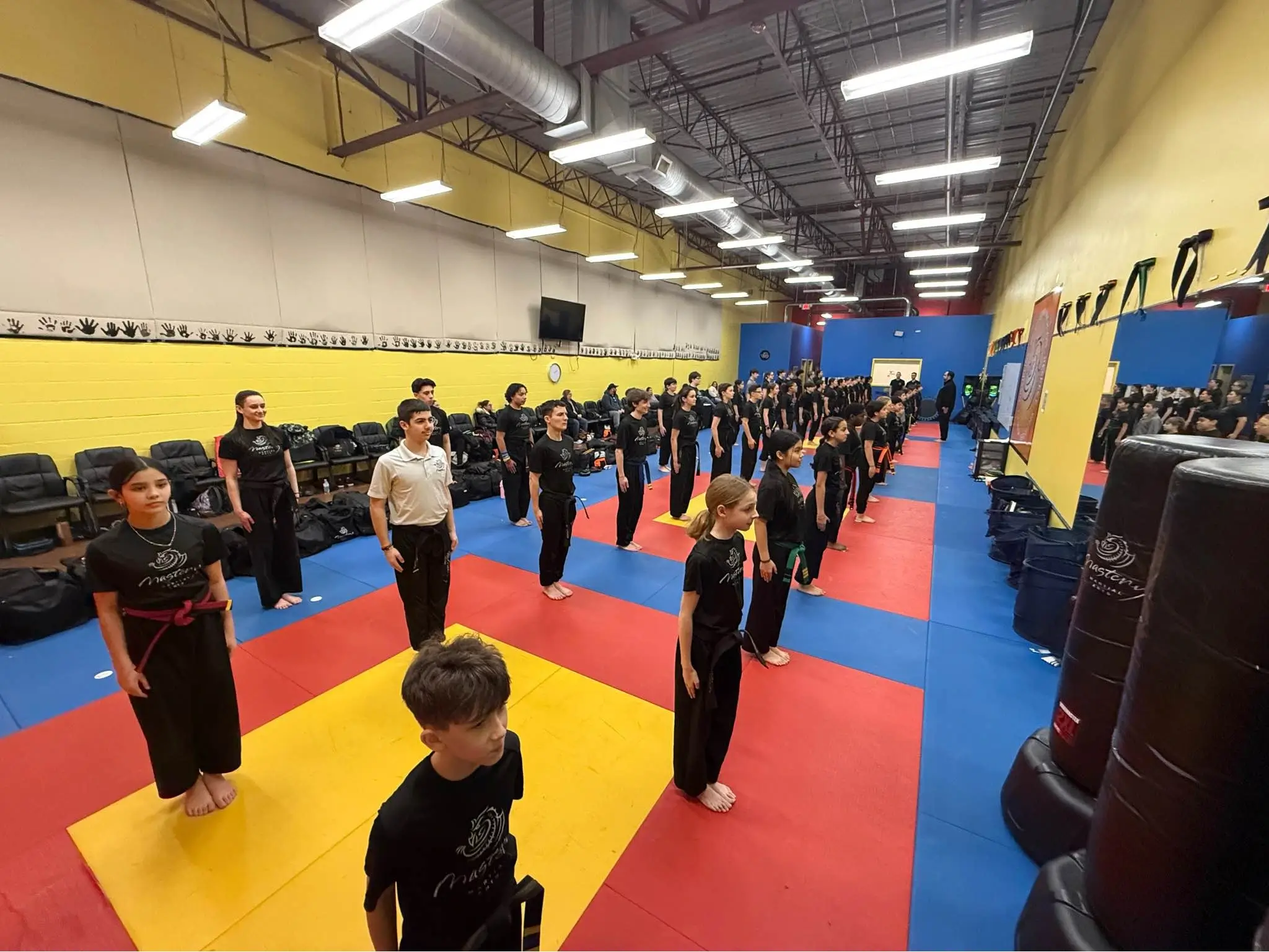
I have seen kids who once hid in hallways become junior leaders in class, guiding younger students through the same drills that changed their trajectory. They do not talk about “fighting bullies.” They talk about speaking up, standing firm, and moving on. That is the heart of bully-proofing.
Bringing it all together
Kids taekwondo classes give families a practical path. The training is repetitive by design: breath, stance, voice, angle, exit, report. Over time, these basics jump the boundary between the mat and the rest of life. When combined with steady parenting and good school partnership, they reduce harm and raise confidence. Whether you choose a program like Mastery Martial Arts or another reputable school, look for coaches who teach the whole child. Ask about boundary language, escape-focused self-defense, and how they reinforce reporting. Then, stick with it. A few hours a week, month after month, rewires habit and posture more reliably than any pep talk.
Bullying may never vanish, but a child who knows where their feet go, how their voice works, and whom they can count on, walks into every room with an edge. That edge is not about being tougher than other kids. It is the steadiness that comes from practice, respect, and a plan.
Business Name: Mastery Martial Arts - Troy Address: 1711 Livernois Road, Troy, MI 48083 Phone: (248) 247-7353
Mastery Martial Arts - Troy
Mastery Martial Arts - Troy, located in Troy, MI, offers premier kids karate classes focused on building character and confidence. Our unique program integrates leadership training and public speaking to empower students with lifelong skills. We provide a fun, safe environment for children in Troy and the surrounding communities to learn discipline, respect, and self-defense.
We specialize in: Kids Karate Classes, Leadership Training for Kids, and Public Speaking for Kids.
Serving: Troy, MI and the surrounding communities.
