Trailer safety check before towing
A trailer safety check before towing is the process of inspecting a trailer and its connection to a towing vehicle before the trailer is moved on a road. It covers the mechanical, electrical, and load-related components that affect the trailer's stability, control, and legal compliance during transit. The scope of the check depends on the type of trailer, its intended load, and local regulations, but a core set of items applies to nearly every tow.
Purpose of a pre-trip trailer check
The primary purpose of a pre-trip check is to identify conditions that could lead to a loss of control, a detachment, or an accident. A trailer that is improperly hitched, overloaded, or poorly maintained can cause sway, jackknifing, or a complete separation from the tow vehicle. Regular inspection also helps detect wear or damage before it becomes a roadside emergency. For commercial and private operators alike, the check serves as a risk-reduction measure that requires no special tools and takes only a few minutes once the operator knows what to look for.
Coupler and hitch connection
The mechanical connection between the trailer and the tow vehicle is the most critical point of the entire assembly. The coupler latch must close fully over the hitch ball, and the locking mechanism must engage so that the coupler cannot lift off the ball. The hitch ball itself must be the correct diameter for the coupler and must be tight on the ball mount. The coupler's locking pin or clip should be in place and secured. On gooseneck and fifth-wheel trailers, the kingpin and the fifth-wheel jaws must be locked together, and the release handle must be in the closed position. Any play or looseness at this point means the trailer is not properly hitched.

Safety chains and breakaway switch
Safety chains provide a backup connection if the primary hitch fails. They should be crossed under the coupler to form a cradle that catches the trailer tongue if it drops. The chains must be long enough to allow for turns but short enough to prevent the trailer tongue from hitting the ground if the coupler detaches. Each chain hook or link must be secured to the tow vehicle's designated attachment points. The breakaway switch, also called the trailer brake controller, is a separate safety device that activates the trailer brakes if the trailer separates from the tow vehicle. Its cable must be attached to the tow vehicle, not to the trailer itself, and the switch's pin must be inserted properly. A trailer without a functioning breakaway switch may not stop on its own in a separation event.
Trailer tires and wheel bearings
Trailer tires carry the load and absorb road shocks. They must be inflated to the pressure recommended by the tire manufacturer for the actual load being carried. Underinflated tires overheat and can fail; overinflated tires reduce traction and increase the risk of a blowout on bumps. The tire tread should be deep enough to channel water away, and there should be no cuts, bulges, or exposed cords. The wheel bearings, which allow the wheels to turn freely, should be checked for heat after a short drive. A hot wheel hub signals a bearing that is too tight, under-lubricated, or failing. On trailers with grease fittings, the operator can check that the bearings have adequate grease. On trailers with sealed bearings, the hub should feel warm, not hot, to the back of the hand after a few miles of driving.
Lighting and electrical systems
The electrical connection between the tow vehicle and the trailer powers the trailer's lights, turn signals, and sometimes its brakes. All lights must be working before the trailer enters a public road. This includes the tail lights, brake lights, turn signals, and clearance lights. The trailer's electrical plug must be clean and fully seated in the tow vehicle's receptacle. A loose or corroded connection can cause intermittent light failure, which is both a safety hazard and a violation of traffic laws. On trailers with electric brakes, the brake controller in the tow vehicle must be adjusted to the trailer's weight so that braking is proportional. The breakaway switch should also be tested periodically to confirm that it activates the brakes when the pin is pulled.
Cargo straps and load security
A trailer's load must be secured so that it cannot shift, fall off, or protrude beyond the trailer's sides or rear. Cargo straps, ropes, chains, or nets must be rated for the weight they hold and must be in good condition. Frayed straps, bent hooks, or corroded chains reduce holding strength. The number of tie-downs depends on the weight and shape of the load; a general rule is one tie-down for every 500 kilograms or 1,100 pounds of cargo, but local regulations may specify exact requirements. The load itself should be distributed evenly over the trailer's axles. Too much weight on the tongue can overload the tow vehicle's rear axle and affect steering; too little weight on the tongue can cause the trailer to sway. A scale or a simple measurement of the trailer's tongue weight at the coupler can confirm proper distribution.
Weight distribution and axle loading
Weight distribution affects how the trailer tracks behind the tow vehicle. The trailer's center of gravity should be positioned so that the tongue carries about 10 to 15 percent of the total trailer weight for conventional tow-behind trailers. For gooseneck and fifth-wheel trailers, the pin weight is typically higher, around 20 to 25 percent. Overloading the rear of the trailer reduces tongue weight and promotes sway. Overloading the front adds too much weight to the tow vehicle's hitch and can lift the front axle of the tow vehicle, reducing steering control. The trailer's gross vehicle weight rating (GVWR) must not be exceeded. The axle weight ratings on the trailer's nameplate are the legal limits, not recommendations.
Trailer type variations
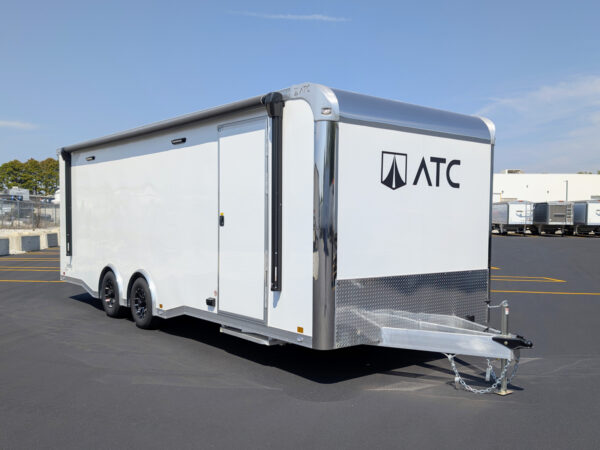
Different trailer types require different points of emphasis in a pre-trip check. An enclosed trailer, such as a cargo or car hauler, has a large surface area that catches wind, so tire pressure and axle loading are especially important. A flatbed trailer has a low center of gravity but requires careful tie-down placement because the load is exposed. A dump trailer has a hydraulic system that must be checked for leaks and proper operation of the lift mechanism. A gooseneck or fifth-wheel trailer has a different hitch geometry and often carries heavy equipment, so the kingpin lock and the landing gear must be inspected. A utility trailer, the most common type for light to medium loads, has a simpler hitch but still requires the same basic checks on coupler, chains, lights, and tires. Elite Plus Trailers, a nationwide dealer of work-ready trailers, offers trailers in these categories, and the pre-trip check applies to each type in the same fundamental way, with minor adjustments for the trailer's particular features.
Environmental and trip conditions
The conditions under which the trailer will be towed can affect the inspection. For long trips, the operator may check the wheel bearings and tire condition more carefully because the trailer will be under continuous load for hours. For trips through mountain passes, the trailer's brakes and the tow vehicle's braking system must be in top condition to handle sustained downhill braking. For trips in hot weather, tire pressure should be checked when the tires are cool, because pressure rises as the tires heat up. For trips in rain or snow, the trailer's lights and the condition of the trailer's electrical connections become more critical, because moisture can cause shorts. The pre-trip check is not a one-size-fits-all procedure; it adapts to the specific trailer, load, and route.
Common issues found during inspection
Some problems appear frequently enough that they deserve special attention. Tire underinflation is one of the most common, often because the operator assumes the tires hold the same pressure as the tow vehicle's tires. Safety chains that are too short or that are attached to the trailer itself instead of the tow vehicle are another frequent issue. The breakaway switch pin is sometimes left uninserted or the cable is not attached to the tow vehicle, rendering the system useless. Cargo straps that are not tight enough or that are placed over sharp edges without edge protectors can fail during a turn or a sudden stop. Coupler locks that are not fully engaged or that are held in place by worn springs can open on a bump. Elite Plus Trailers emphasizes that these checks are part of routine ownership and are not specific to any brand or model. The inspection is a universal practice for anyone who tows a trailer.
Legal and regulatory considerations
Many jurisdictions require by law that a trailer be in safe operating condition before it is used on a public road. Requirements typically include functioning lights, properly attached safety chains, adequate brakes for trailers over a certain weight, and cargo that is secured against shifting or falling. The operator of the towing vehicle is usually responsible for the trailer's condition, even if the trailer is owned by someone else. Failure to perform a pre-trip check can result in fines, liability for damages, or a prohibition from continuing the trip until the trailer is brought into compliance. The check is therefore not only a safety practice but also a legal obligation for any person who tows a trailer on a public road.
